
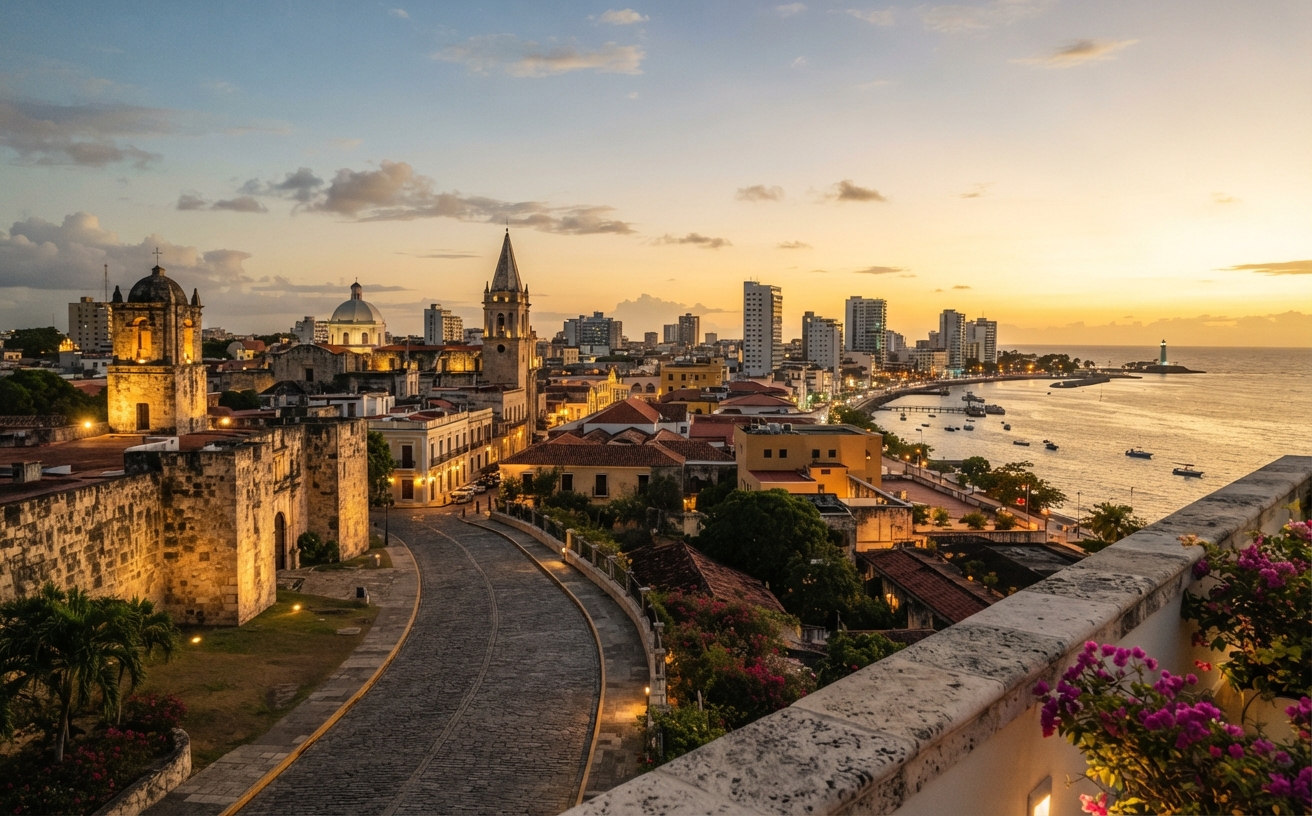
City overview
The Dominican Republic shares Hispaniola with Haiti and offers more variety than anywhere else in the Caribbean, from Punta Cana's resorts to colonial Santo Domingo and the laid-back north coast around Puerto Plata. Jewish infrastructure here is the best in the region, entirely built by Chabad of the Dominican Republic under Rabbi Shimon Pelman, who also serves as shochet. Santo Domingo has a daily and Shabbos minyan, a mikvah, and Rimon Kosher Market — a full kosher supermarket with its own restaurant, a rarity in the Caribbean. A second Chabad centre opened on the north coast in Puerto Plata in 2025 with its own kosher restaurant and Shabbos services. Kosher catering delivers island-wide, including to Punta Cana resorts, though Punta Cana itself has no year-round kosher restaurant, permanent shul, or eruv.
Getting Around
Public transit
Guaguas — privately run minivans following loose routes — are the local way to travel within and between towns.
They are very cheap, frequent and crowded, with no fixed schedule and no fixed stops. For longer distances, Caribe Tours and Metro Servicios Turísticos run modern air-conditioned coaches between the main cities at roughly US$5 to US$10 for a multi-hour journey, with reclining seats and luggage storage — comfortable, reliable and the sensible way to cross the country without a car. Santo Domingo also has a two-line metro.
Rideshare
Uber works well in Santo Domingo with standard UberX service.
In Punta Cana it is less useful: UberX drivers are generally blocked from entering resort gates, so the app defaults to Uber Select, which dispatches conventional taxis at higher prices. Taxis outside official airport ranks are unmetered — agree the fare before getting in. Motoconcho motorcycle taxis are widely available and best avoided.
Car rental
All the international agencies operate at the main airports and in the resort areas.
A home driving licence is valid for the length of a tourist stay, and local liability insurance is compulsory on top of whatever your card covers. Driving is on the right. Roads between the main centres are good, particularly the Santo Domingo–Punta Cana and Santo Domingo–Puerto Plata highways, but rural roads are rough and traffic behaviour is unpredictable. A car is worth having on the north coast and for the interior; unnecessary at a Punta Cana resort.
Airport
The Dominican Republic has four significant international airports, which is unusual for a Caribbean country and means you can generally fly straight to your region without a domestic connection. Punta Cana International Airport (PUJ) is the busiest, serving the east-coast resort belt, with an open-air thatched-roof terminal. Reckon on 20 to 35 minutes to Bávaro and Punta Cana, 15 to 20 minutes to Cap Cana and 40 to 50 minutes to Uvero Alto. Las Américas International Airport (SDQ), formally José Francisco Peña Gómez, serves Santo Domingo from about 25 km south-east of the city — 25 to 35 minutes to the centre, and roughly 50 minutes to Chabad in Piantini. This is the airport to use if you want the kosher infrastructure, and Uber picks up here. Gregorio Luperón International Airport (POP) serves the north coast at Puerto Plata: 15 to 25 minutes to Puerto Plata and the Chabad centre at Playa Dorada, 15 to 20 minutes to Sosúa and 25 to 30 minutes to Cabarete. Cibao International Airport (STI) at Santiago serves the interior, 15 to 20 minutes from Santiago and about an hour from Jarabacoa.
Good to know
Best time to visit
December through April is the dry season, with warm days around 25°C to 28°C and up to ten hours of sunshine, while hurricane season runs June 1 through November 30 and September and October carry the greatest risk.
Insider tips
Decide early whether your trip is built around kosher food or around the beach, because in the Dominican Republic those point to different places. Santo Domingo has the daily minyan, the mikvah and Rimon Kosher Market with its restaurant; Puerto Plata has a kosher restaurant and Shabbos services; Punta Cana, where most people actually stay, has neither and depends on ordering ahead. Chabad's catering delivers island-wide but wants notice — twenty-four hours minimum for packages, and up to a week for full catering, so place orders before you fly rather than on arrival. If you want Punta Cana with kosher food, look at the organised Yeshiva Week and Pesach programmes that take over resorts there, or at villa rentals with catering delivered in. There is no eruv anywhere in the country. Book hotels within walking distance of Chabad in Santo Domingo's Piantini district if Shabbos davening matters — several international chains sit seven to fifteen minutes' walk away. Carry small peso notes for guaguas and tips; US dollars are accepted at resorts but you will get a poor rate. Tap water is not drinkable, so stick to bottled. The all-inclusive model dominates the east coast and is of no use to a kosher traveller, which makes room-only rates and villas better value than they first look.
Safety & emergency
The resort areas of Punta Cana, Bávaro, Cap Cana and Casa de Campo are gated, heavily policed and very safe. Santo Domingo's Zona Colonial and Piantini are comfortable by day and reasonable at night on the main streets, but other parts of the capital warrant care after dark and walking with a phone visible invites trouble. The north coast around Sosúa and Cabarete is relaxed but has more petty crime than the east. The practical risks for most visitors are traffic and water. Driving standards are poor, lane discipline is loose and unlit vehicles and motorbikes are common at night — night driving between cities is best avoided. Motoconcho motorcycle taxis have no helmets and a bad safety record; skip them. Beaches on the Atlantic north coast have real rip currents and few lifeguards, unlike the calm Caribbean south and east. Tap water is not safe to drink anywhere. There is a dedicated tourist police force, CESTUR, whose officers speak English and are the right people to call for anything visitor-related. • Police, Fire and Ambulance (all emergencies): 911 — free from any phone, with multilingual operators • CESTUR / POLITUR tourist police: (809) 200-3500 and (809) 222-2026, 24 hours • CESTUR Punta Cana: (809) 754-3076 • CESTUR Puerto Plata: (809) 320-0365 • National Police: (809) 682-2151 • Red Cross ambulance: (809) 682-4545 • Hospiten Bávaro, Punta Cana: (809) 686-1414 • Hospital General de la Plaza de la Salud, Santo Domingo: (809) 565-7477
Local time
2:37 AM
+4 hrs from NYC
Plug
Type A/B
110V
Currency
Dominican Peso
Kosher map of Dominican Republic
Pick a place on the map or search an address or hotel to see what is kosher around it.