
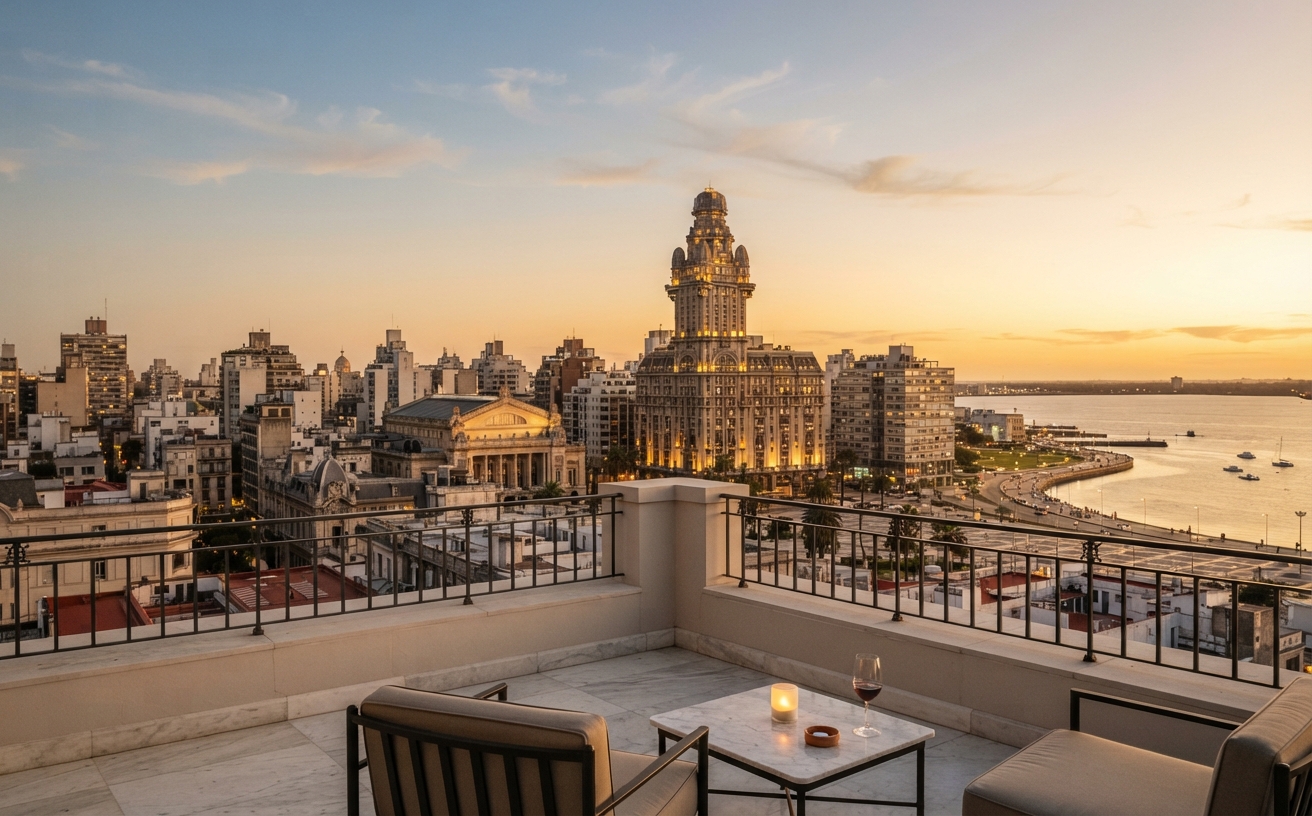
City overview
Montevideo is South America's most unhurried capital: a low, walkable city wrapped by 22 kilometres of Rambla, where art deco towers, cobbled Ciudad Vieja streets and wide river beaches sit within a few minutes of each other. It is relaxed, safe by regional standards and refreshingly uncrowded. Uruguay's Jewish life is concentrated almost entirely here, clustered in the leafy seaside neighbourhoods of Pocitos and Punta Carretas, where the Chabad House, the Sephardi congregation and the Yavne campus all sit within walking distance of one another and of most kosher dining.
Getting Around
Public transit
Montevideo runs on a single metropolitan bus network rather than a metro.
Pick up a free STM travel card at an STM office with a passport: it lowers the fare and lets you transfer between lines within one to two hours on the same trip. The Como Ir app shows routes, stops and live times. The CE1 line is a fully electric service linking the Tres Cruces terminal and the stadiums to Ciudad Vieja.
Rideshare
Both Uber and Cabify operate normally across Montevideo, including airport runs, and are usually the simplest option for visitors.
Fares are modest by North American or European standards.
Car rental
International and Uruguayan rental agencies operate at Carrasco airport and in the city.
A car is unnecessary for Montevideo itself, where almost everything of interest sits along the Rambla, but it is useful for day trips to Colonia del Sacramento or the Atlantic coast. Driving is on the right.
Airport
Carrasco / General Cesareo L. Berisso International Airport (MVD). Montevideo's single international gateway sits 19 kilometres east of downtown, on the Carrasco side of the city, roughly 25 to 35 minutes by car to Pocitos or Punta Carretas depending on traffic. It is a modern, calm, single-terminal airport designed by Rafael Vinoly, with the departure and arrival levels stacked under one long curved roof. Uber and Cabify both serve the terminal, licensed airport taxis queue outside arrivals, and a tourist information desk on +598 2604 0329 can advise on transfers and car hire. Most flights connect through Buenos Aires, Sao Paulo, Santiago or Panama City.
Good to know
Best time to visit
October through April is warmest and driest for the Rambla and the beaches, with January and February the hottest and busiest months.
Insider tips
Kosher dining in Montevideo runs on a schedule rather than an address: several of the city's kosher options are ordinary restaurants that serve under supervision only on set nights, so plan meals around the days rather than turning up and hoping. Almost everything Jewish sits in Pocitos and Punta Carretas, so staying in either puts the Chabad House, the Sephardi congregation and most kosher food within a walk. Uruguayans eat late, and 9:00 PM is a normal dinner hour. Cash is still useful at markets and small cafes, though cards are accepted almost everywhere. Pack a light layer even in summer, because the wind off the River Plate turns the Rambla cool after sunset.
Safety & emergency
Montevideo is one of the safer capitals in South America, and the Pocitos, Punta Carretas and Carrasco neighbourhoods where most visitors stay are calm day and night. Ordinary city caution applies: keep phones out of sight around Ciudad Vieja after dark and near the port, use licensed taxis or a rideshare app late at night, and avoid the area around the bus terminal at night. Tap water is safe to drink throughout the city. Police emergency: 911. Ambulance (Ministry of Public Health): 105. Fire brigade: 104. Maritime emergencies: 1767. National Burn Centre: 2487 2020. Montevideo city services: 1950
Local time
2:34 AM
+4 hrs from NYC
Plug
Type C / F / L
230V
Currency
Uruguayan Peso
Kosher map of Montevideo
Pick a place on the map or search an address or hotel to see what is kosher around it.