
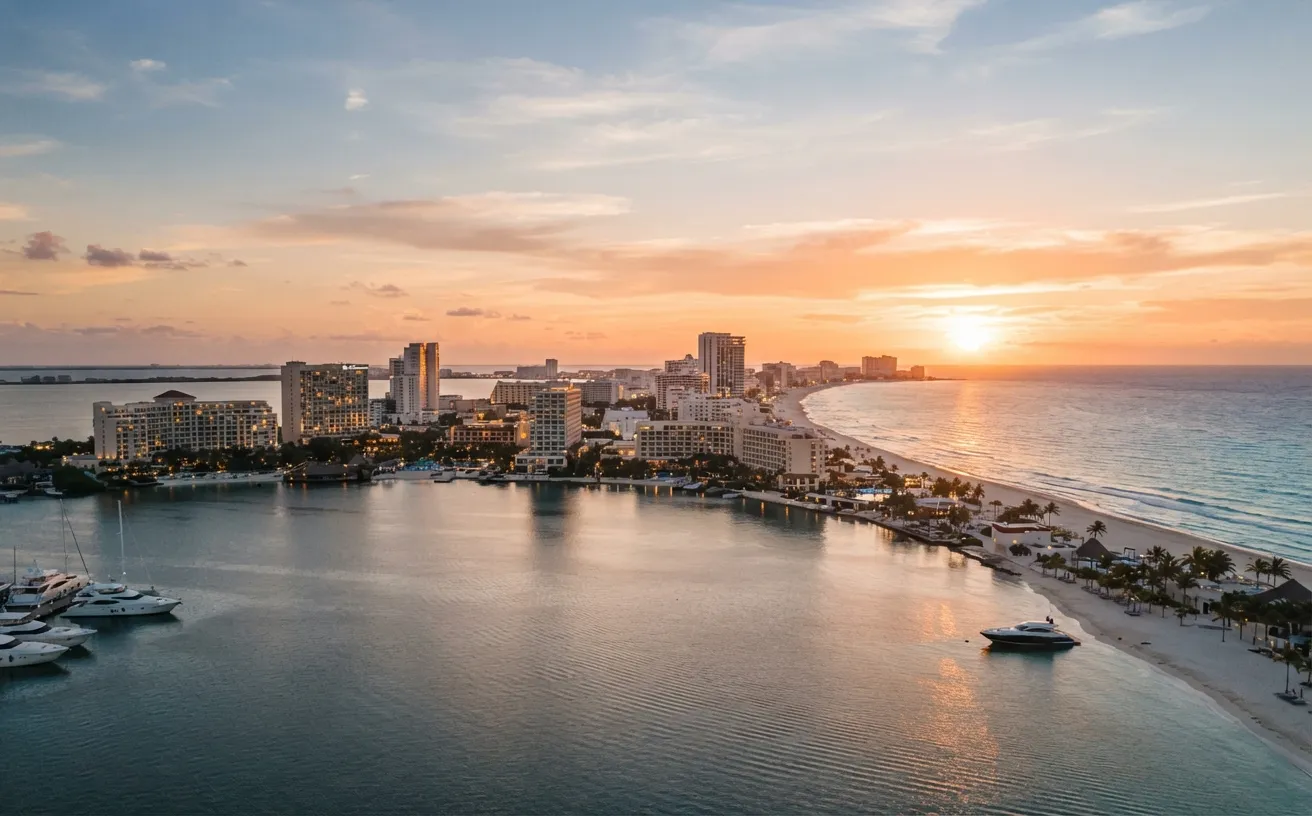
City overview
Cancun is Mexico's best-known Caribbean resort city, a seventeen-mile barrier island of white sand and turquoise water lined end to end with resorts, with a working Mexican city of nearly a million people behind it and the Maya interior a short drive inland. Isla Mujeres lies a twenty-minute ferry ride offshore and trades the high-rise strip for golf carts, a walkable town centre and the calm shallow water of Playa Norte. Between them they cover almost every kind of trip, from all-inclusive beach weeks to diving, Maya ruins and day sails. Jewish travel here is unusually well served for a resort destination: Chabad Jewish Center of Cancun sits inside Kukulcan Plaza in the heart of the Hotel Zone, Cancun's own Orthodox community, Neve Shalom, numbers around forty-eight families, and Chabad of Isla Mujeres runs a shul and a kosher restaurant on the island itself. Three certified restaurants operate in the Hotel Zone under Mexican supervision, and both Chabad houses serve Shabbat meals to visitors who book ahead.
Chabad in Cancun
2 Chabad centers
Getting Around
Public transit
Cancun's city buses are the cheapest and most useful way to move along the Hotel Zone.
The R1 runs between downtown and the Hotel Zone and some R1 buses continue to Puerto Juarez for the Isla Mujeres ferry; the R2 covers the Hotel Zone but does not reach Puerto Juarez; the R10 is the most direct line to the Ultramar ferry terminal. Fares are 12 pesos for Hotel Zone and Puerto Juarez journeys and 10 pesos within downtown, paid in cash to the driver, who does not carry much change. Buses run roughly 6:00 AM to 10:30 PM, every five to ten minutes on the R1 and every fifteen to twenty on the R10; check the destination sign in the windscreen before boarding. Ultramar and Marinsa ferries cross to Isla Mujeres from Puerto Juarez / Gran Puerto in fifteen to twenty minutes, roughly every thirty minutes from early morning to mid-evening, with slower and more expensive Hotel Zone departures from Playa Tortugas and Playa Caracol and a separate vehicle ferry from Punta Sam. On Isla Mujeres itself the island is small enough to walk in the centre, and rented golf carts are the normal way to reach the south end. ADO coaches leave the downtown bus terminal for Playa del Carmen, Tulum, Merida and Chichen Itza, and the Tren Maya station beside the airport connects west toward Chichen Itza and Merida and south toward Tulum and Chetumal.
Rideshare
Uber operates legally in Cancun and is generally cheaper than a taxi for Hotel Zone and downtown journeys.
It cannot pick up at Cancun International Airport, where only licensed airport transport may collect arriving passengers, though it can be used to travel to the airport from a hotel. DiDi, inDrive and Lyft do not currently operate in Cancun. Taxis are widely available and priced by zone rather than by meter, so confirm the fare before setting off.
Car rental
All the major international agencies and a large number of Mexican ones operate at Cancun International Airport and in the Hotel Zone.
Mexican third-party liability insurance is compulsory and cannot be waived by a credit card policy, so expect it to be added at the counter and budget for it rather than treating a very low advertised daily rate at face value. A car is not needed for a stay confined to the Hotel Zone, where buses and taxis cover everything, but it is genuinely useful for Chichen Itza, the cenotes and the coast road south. Cars are not taken to Isla Mujeres by most visitors; golf carts are rented on the island instead.
Airport
Cancun International Airport (CUN) is the second busiest airport in Mexico, handling just over 29 million passengers in 2025, and has four passenger terminals — more than any other Mexican airport. It sits less than ten kilometres southwest of the Hotel Zone, which is a twenty to thirty minute drive depending on traffic and on how far along Boulevard Kukulcan the hotel lies; downtown Cancun is closer, and Puerto Juarez for the Isla Mujeres ferry is about thirty to forty minutes. Only licensed transport may collect passengers at the terminals, so pre-book a transfer or use the authorised airport taxi and shuttle desks rather than expecting to summon a rideshare on arrival. A Tren Maya railway station opened next to the airport in 2023, linked to all four terminals by a shuttle bus, with services running west toward Chichen Itza and Merida and south toward Tulum and Chetumal.
Good to know
Best time to visit
December through April is the driest and least humid stretch, with daytime temperatures in the low to mid 80s Fahrenheit and the clearest water, while the June-to-November hurricane season brings heat, heavy humidity and the year's most rainfall in September.
Insider tips
Pay in pesos rather than dollars wherever you are given the choice; businesses that accept dollars set their own poor rate. Withdraw from bank ATMs rather than the free-standing machines in hotel lobbies and shopping plazas. The Hotel Zone is a single boulevard with kilometre markers running from downtown at Km 0 out to Punta Nizuc at Km 22, and giving a driver the km number is more useful than a street address. Kosher restaurants cluster between Km 8 and Km 15, close to the Chabad centre at Km 13, which makes that middle stretch the most convenient base for a kosher traveller. Meat restaurants prepare Shabbat takeaway menus and need ordering ahead. Sargassum seaweed can affect the open Caribbean beaches between April and August, heaviest in June through August; the lagoon-facing and north-facing beaches, including Playa Norte on Isla Mujeres, are usually unaffected. Tipping runs around 10 to 15 percent in restaurants, and it is worth checking whether service has already been added.
Safety & emergency
Cancun's Hotel Zone, the downtown tourist corridor along Avenida Tulum and Isla Mujeres are all heavily policed and generally comfortable to walk, including after dark on the main strips. Ordinary precautions apply rather than exceptional ones: use ATMs inside banks rather than free-standing machines, agree a taxi fare before getting in since Cancun taxis are zone-priced rather than metered, decline dynamic currency conversion at card terminals, and treat the sea itself as the real hazard — pay attention to the coloured beach flag system, since the open Caribbean side of the Hotel Zone can have strong undertow even on calm-looking days. Tap water is not drinkable anywhere in the region, including at resorts. Emergency numbers: 911 for all emergencies nationwide, with bilingual operators; 089 for anonymous crime reporting; 078 for Angeles Verdes roadside and tourist assistance on federal highways; Cancun Tourist Police (Hotel Zone) 998 885 2277; Cruz Roja Cancun 998 884 1616; Cancun Fire Department 998 884 1202; Cancun Civil Protection 998 887 4341; Isla Mujeres Police 998 877 0458; Isla Mujeres Cruz Roja 998 877 0280; Isla Mujeres Health Centre 998 877 0117; Guest Assist tourist assistance line 800 277 4780; United States Consular Agency Cancun 55 8526 2561.
Plug
Type A/B
127V
Currency
Mexican Peso
About Chabad in Cancun
Cancun has 2 Chabad centers.
Kosher map of Cancun
Pick a place on the map or search an address or hotel to see what is kosher around it.
Frequently asked about Cancun
Do I need a visa to visit Cancun?
Citizens of the United States, Canada, the United Kingdom, the European Union, Israel and many other countries do not need a visa for tourism and may stay up to 180 days, with the actual period set by the immigration officer. Arriving by air, the tourist permit is issued digitally during immigration processing and its cost is included in the airfare, so there is no separate paper form to fill in or fee to pay at the airport. Paper forms and a fee still apply at land borders.
Can I drink the tap water?
No. Tap water is not drinkable anywhere in the region, including inside resorts, and locals do not drink it either. Use bottled or purified water, which every hotel supplies. Ice and washed produce at established restaurants and resorts are made with purified water and are fine.
What currency is used and should I pay in dollars or pesos?
The Mexican peso. Many businesses in the Hotel Zone will accept US dollars but at an exchange rate they set themselves, which is consistently worse than the bank rate, so paying in pesos is cheaper. Decline dynamic currency conversion when a card terminal offers to bill you in your home currency, and withdraw from ATMs inside banks rather than free-standing machines.
How much should I tip?
Around 10 to 15 percent in restaurants, checking first whether service has already been added to the bill. Roughly 20 pesos a round for bartenders, 50 to 100 pesos a day for hotel housekeeping, 10 to 15 percent for tour guides and 100 to 200 pesos per person for boat crews on a day trip. Taxi drivers are not normally tipped unless they help with luggage.
What language is spoken?
Spanish. English is widely spoken throughout the Hotel Zone, at the airport, in resorts and by most tour operators, and is common on Isla Mujeres too. A little Spanish is useful downtown, on the city buses and in the smaller shops.
What plugs and voltage does Mexico use?
Type A and Type B sockets, the same flat two-prong and three-prong plugs used in the United States and Canada, at 127 volts and 60 Hz. North American visitors need no adapter. European, Israeli and Australian visitors need a Type A adapter and should check that their devices handle 127 volts.
Is Uber available in Cancun?
Yes, Uber operates legally in Cancun and is usually cheaper than a taxi. It cannot pick up at the airport, where only licensed airport transport may collect arriving passengers, although you can take an Uber to the airport when leaving. DiDi, inDrive and Lyft do not operate in Cancun. Taxis are priced by zone rather than metered, so agree the fare before you set off.
How do I get from the airport to my hotel?
Cancun International Airport is less than ten kilometres from the Hotel Zone, a twenty to thirty minute drive. Pre-book a private transfer or use the authorised taxi and shuttle desks inside the terminal, since rideshare cannot collect at the airport. If you are heading to Isla Mujeres, allow thirty to forty minutes to Puerto Juarez for the ferry.
How do I get to Isla Mujeres?
Ultramar and Marinsa ferries run from Puerto Juarez, also signposted as Gran Puerto, on the mainland just north of downtown Cancun. The crossing takes fifteen to twenty minutes and departures are roughly every thirty minutes from early morning until mid-evening. Slower and more expensive departures also run from Playa Tortugas and Playa Caracol in the Hotel Zone, and a separate vehicle ferry runs from Punta Sam.
Do I need a car?
Not for a stay in the Hotel Zone, which is one boulevard served by frequent buses and plentiful taxis. A car is genuinely useful for Chichen Itza, the cenotes and the coast road south. If you rent, remember that Mexican third-party liability insurance is compulsory and cannot be replaced by a credit card policy, so it will be added at the counter. On Isla Mujeres, visitors rent golf carts rather than cars.
When is the best time to visit?
December through April is the driest and least humid stretch, with temperatures in the low to mid 80s Fahrenheit. Hurricane season runs from early June to the end of November, with the greatest risk between August and October and the heaviest rain in September. Direct hits are uncommon but the humidity and afternoon storms are a real feature of the summer.
What is sargassum and will it affect my beach?
Sargassum is a brown seaweed that drifts onto the open Caribbean-facing beaches, typically between April and August and heaviest from June to August. Volumes vary enormously year to year and week to week. Beaches facing north or into the lagoon, including Playa Norte on Isla Mujeres and the northern end of the Cancun Hotel Zone, are usually much less affected than the long east-facing stretch.
Is there an eruv in Cancun or on Isla Mujeres?
No. Neither Cancun nor Isla Mujeres has an eruv, and both Chabad centres state this for visitors. Nothing may be carried outdoors on Shabbat in either place, so walking distance from your hotel to a shul is worth planning around.
Where should I stay to be within walking distance of a shul?
In Cancun, the Hotel Zone resorts between roughly Km 9 and Km 14 of Boulevard Kukulcan put the Chabad centre at Kukulcan Plaza, Km 13, within a comfortable walk, and the same stretch holds the three certified kosher restaurants. On Isla Mujeres, the town centre and Playa Norte hotels are two to eight minutes on foot from the Chabad House.
All kosher listings in Cancun
Kosher restaurants, bakeries and groceries in Cancun (9)
- Vico's Grill Kosher Cancun
Kosher grill house in the Hotel Zone · Zona Hotelera, Cancun
- The Ember Kosher Cancun
Glatt kosher meat restaurant, Mexican-Israeli cooking · Zona Hotelera, Cancun
- Shalom - Chabad Isla Mujeres
The island's kosher meat restaurant, run by Chabad · Centro, Isla Mujeres
- Kosher Italian Gourmet
Kosher dairy Italian kitchen in Plaza Quetzal · Zona Hotelera, Cancun
Shuls and minyanim in Cancun (3)
- Chabad Jewish Center of Cancun
Chabad-Lubavitch, Nusach Ari · Zona Hotelera, Cancun
- Chabad of Isla Mujeres
Chabad-Lubavitch, Nusach Ari · Centro, Isla Mujeres
- Comunidad Judia de Cancun - Neve Shalom
Modern Orthodox, mixed Ashkenazi and Sephardi · Downtown Cancun
Shabbos meals in Cancun (2)
- Shabbat Meals at Chabad Jewish Center of Cancun
Friday night dinner and Shabbat lunch at the Chabad centre · Zona Hotelera, Cancun
- Shabbat Meals at Chabad of Isla Mujeres
Shabbat and holiday meals on the island, by registration · Centro, Isla Mujeres
Chabad centers in Cancun (2)
- Chabad Jewish Center of Cancun
Zona Hotelera, Cancun
- Chabad of Isla Mujeres
Centro, Isla Mujeres