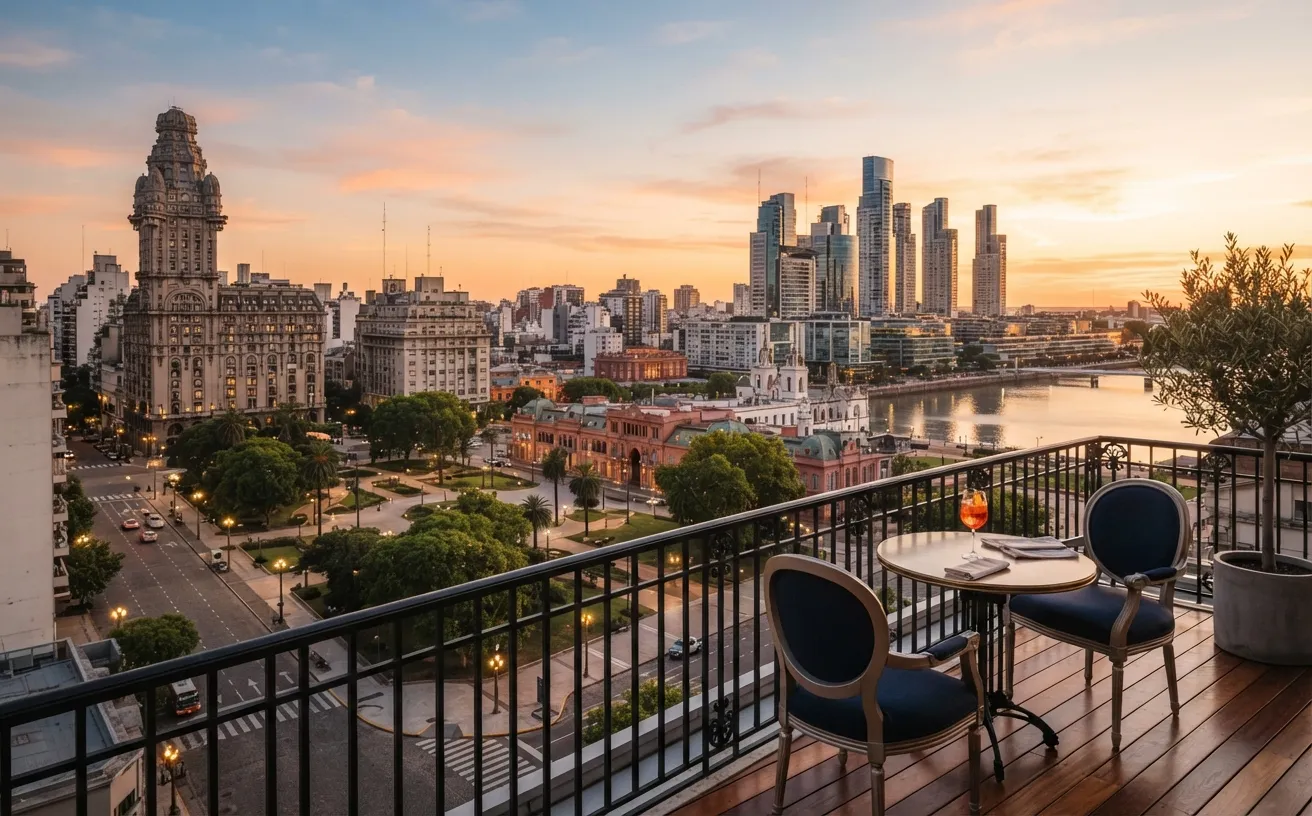
Buenos Aires holds the largest Jewish community in Latin America, and its Orthodox life is spread across several barrios rather than one neighborhood. Once (Balvanera) is the historic core: the streets around Tucumán, Paso, San Luis, Ecuador, Viamonte and Pueyrredón carry dozens of shuls, kosher restaurants, bakeries, butchers and groceries within a few blocks. Flores, to the west, has a large Sephardi and Haredi community with its own shuls and the Pasaje Valle food arcade on Argerich, while Belgrano, Palermo, Recoleta and Barrio Norte to the north have Chabad houses, Ajdut Israel's shul and mikvah on Moldes, and a growing cluster of kosher cafés, sushi and pizza.
Chabad runs about thirty houses across the city and the northern suburbs, including the movement's headquarters synagogue on Agüero in Barrio Norte and Chabad of Buenos Aires on Moreno, which caters to visitors and Israeli travelers with Shabbos meals. Kosher supervision is mainly by Ajdut Kosher and by Iahadut HaTora's Kashrut LeMehadrin, alongside places under named local rabbis, and the kosher McDonald's at the Abasto shopping centre is one of very few outside Israel.
For a Shabbos stay, choose the barrio first: Recoleta and Barrio Norte hotels put you within walking distance of Agüero and the Recoleta Chabad houses, Once has the densest kosher food and many shuls but simpler hotels, and Puerto Madero's Alvear Icon has kosher dining in the building. The intercommunity eruv announced for Palermo, Barrio Norte, Recoleta, Once and Villa Crespo has been in use since April 2025.
The barrios of Palermo, Barrio Norte, Recoleta, Once and Villa Crespo, with the exact boundary shown on the published map (Erub Buenos Aires Intercom. 2026).
Friday night dinner and Shabbat lunch at the Chabad House for tourists
Moreno 2095, Balvanera, Buenos Aires, Argentina
Chabad of Buenos Aires – Shabbat Meals for Visitors
Buenos Aires
Cost
Friday night dinner or Shabbat lunch: adult USD 40; children 3–10 USD 15; babies 0–2 free; IDF soldiers USD 20; supporter USD 180
The Chabad House for tourists in Balvanera hosts Friday night dinners and Shabbat lunches for visitors and locals, with kosher food and a warm welcome; it also runs Thursday night asados and other weekly meals.
How it works
Reserve and pay through the online booking on the Shabbat page, choosing the date and dine-in, pickup or delivery. No booking deadline is published; reserve ahead, ideally by Thursday.
Shabbat kit and kosher meals for guests of 1828 Smart Hotel
F. J. Santa María de Oro 1828, Palermo, Buenos Aires, Argentina
Kosher map of Buenos Aires
Pick a place on the map or search an address or hotel to see what is kosher around it.
Frequently asked about Buenos Aires
Do I need a visa to visit Argentina?
Citizens of the United States, Israel, the United Kingdom, Canada, Australia and all European Union countries need only a valid passport for tourist stays of up to three months; no Argentine visa is required. Argentine consulates publish the rules for other nationalities.
How do I get from the airport to the Jewish neighborhoods?
Most international flights land at Ezeiza (EZE), about 32 km and roughly 50 minutes by road from the centre; taxis and booked transfers wait outside arrivals, and Tienda León buses run to its terminal at Pellegrini 971. Aeroparque (AEP), used for domestic and regional flights, is in Palermo, about 25 minutes from Recoleta, Barrio Norte and Once.
Do I need a car in Buenos Aires?
No. The Subte, buses and metered taxis cover the city, and the main Orthodox areas (Once, Barrio Norte, Recoleta, Palermo, Belgrano and Flores) are on or near Subte Lines B and D. Traffic and parking are difficult, so most visitors manage without a car.
Is there an eruv in Buenos Aires?
Yes. The Erub Buenos Aires Intercomunitario, organized by Menora at the initiative of Gran Rabino Isaac Sacca, has been in use since Shabbat HaGadol in April 2025 and was announced as covering Palermo, Barrio Norte, Recoleta, Once and Villa Crespo; its map is published by Menora. Some local rabbis do not rely on it.
Where is the kosher food in Buenos Aires?
The largest cluster is in Once, on and around Tucumán, Paso, San Luis, Ecuador, Viamonte and Pueyrredón, with restaurants, bakeries, butchers and kosher supermarkets. Flores has the Pasaje Valle food arcade on Argerich and shops on Avenida Avellaneda, and Palermo, Belgrano and Recoleta have kosher cafés, sushi, burgers and pizza. Puerto Madero's Alvear Icon hotel has a glatt kosher meat restaurant and a dairy sushi bar.
Who certifies kosher food in Buenos Aires?
The main agencies are Ajdut Kosher, which also publishes a list of certified supermarket products, and Iahadut HaTora's Kashrut LeMehadrin. Some places are supervised by a named local rabbi, and each listing names its certifier where one is published.
Can I find kosher products in ordinary supermarkets?
Yes. Many everyday brands in Argentine supermarkets are certified, and Ajdut Kosher's product list shows which ones. For meat, cheese and Israeli products, use the dedicated kosher supermarkets in Once, Belgrano and Palermo.
Which area should I stay in for Shabbos?
Choose by the shul you want to walk to. Recoleta and Barrio Norte hotels are within walking distance of the Chabad headquarters synagogue on Agüero and the Recoleta Chabad houses; Once has the most shuls and kosher food but simpler hotels; Belgrano suits visitors davening at Ajdut Israel on Moldes; and the Alvear Icon in Puerto Madero has kosher dining in the building.
How do Shabbos meals work for visitors?
Chabad of Buenos Aires on Moreno sells Shabbos dinner and lunch for visitors in advance online, and Beit Jabad Recoleta hosts guests who register through its hospitality form. Kosher caterers and restaurants also sell Shabbos food boxes that must be ordered by Thursday, since kosher restaurants close for Shabbos.
What is open on Shabbos?
Kosher restaurants, bakeries and groceries close from Friday afternoon until Shabbos ends. Shuls and Chabad houses hold Shabbos services, and parks, plazas and outdoor sights such as Caminito and the Puerto Madero waterfront can be reached on foot from nearby hotels.
Where are the mikvaot in Buenos Aires?
Women's mikvaot include Mei Menajem at Malabia 2180 in Palermo, Ajdut Israel's mikvah at Moldes 2449 in Belgrano, Mikve Mei Tzipora at Tucumán 2926 in Once, and Jabad Flores at Argerich 925 in Flores. Appointments are arranged directly with each mikvah.
Are there shuls with daily minyanim?
Yes. Once, Flores, Belgrano and Barrio Norte have shuls with daily minyanim, including the Chabad headquarters synagogue on Agüero and the large Sephardi shuls of Once and Flores. Visitors usually find a weekday minyan within a few blocks in these barrios.
Is Buenos Aires safe for Jewish visitors?
Visitors use normal big-city care: keep phones and valuables out of sight, use official taxis at night, and avoid poorly lit areas around the stations. Jewish institutions have security at the door and usually ask visitors for identification.
What currency and plugs are used?
Argentina uses the Argentine peso (ARS); prices change often, and some hotels and services quote US dollars. Electricity is 220V, and outlets take Type I plugs, with Type C also common, so bring an adapter.
All kosher listings in Buenos Aires
Kosher restaurants, bakeries and groceries in Buenos Aires (107)