
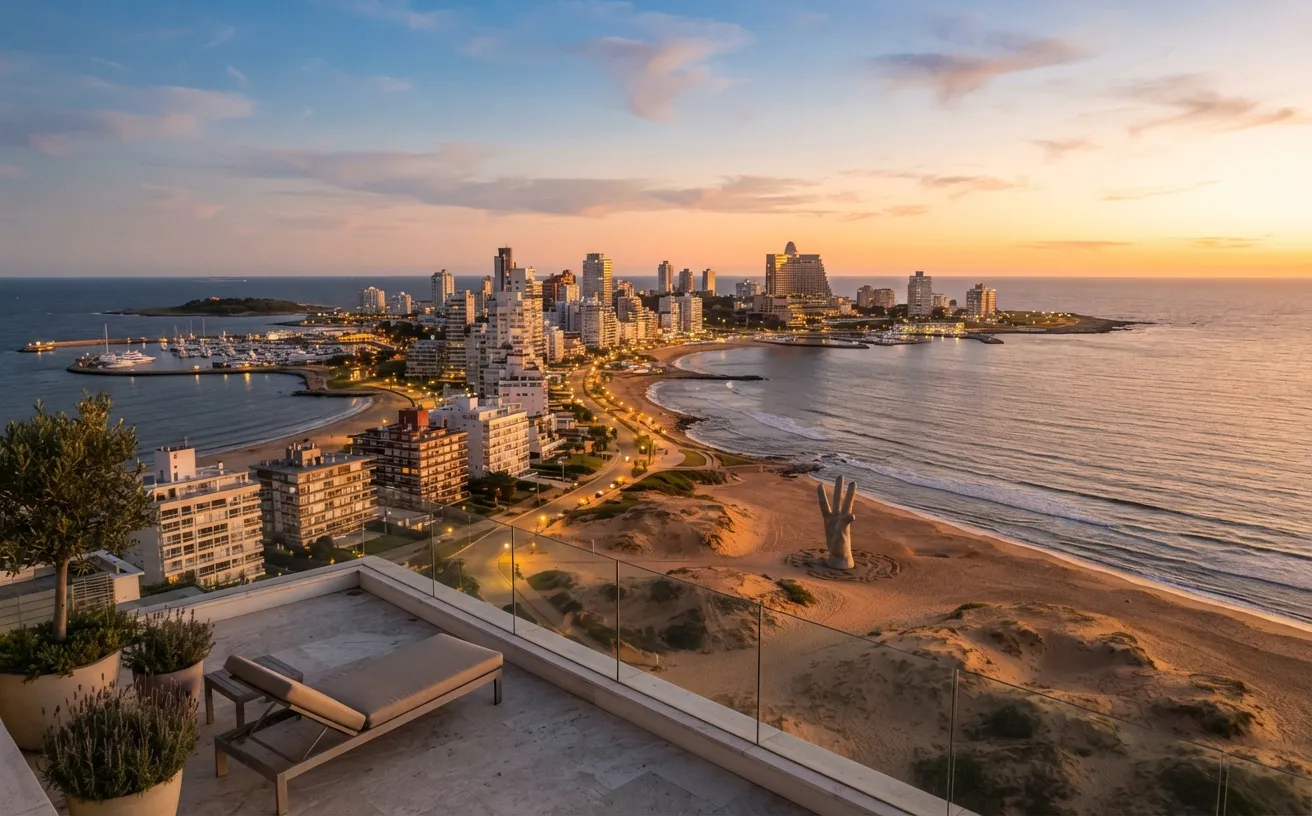
City overview
Punta del Este is Uruguay's best-known beach resort, a narrow peninsula on the Atlantic about two hours east of Montevideo, and every summer it becomes one of South America's busiest Jewish holiday spots. Families from Buenos Aires, São Paulo and Montevideo fill the apartments along Playa Mansa and Playa Brava, and the community's shuls, kosher restaurant menus and Shabbos programmes come to life for the season. Jewish life centres on a handful of addresses: Beit Jabad's Ajdut Israel synagogue at Parada 13½ on the Playa Mansa side, the Sephardi Beit Yaacov synagogue next to the bus terminal, Templo Rafael on the old Península near the lighthouse, and the Menora community centre Ahavat Jinam on Avenida Roosevelt, which also has a kosher dairy pizzeria and a mikveh. Kosher supervision in Uruguay is provided by Uruguay Kosher, the rabbinate of the Comunidad Israelita del Uruguay (Kehilá). Outside the December to March season the town is far quieter and many places close or shorten their hours. Beyond the beaches, Casapueblo at Punta Ballena, the boat trips to Isla de Lobos and Isla Gorriti, and the galleries of Manantiales and La Barra make easy day outings.
Chabad in Punta Del Este
1 Chabad center

Getting Around
Public transit
COPSA and COT run frequent intercity coaches from Montevideo's Tres Cruces terminal and from Carrasco International Airport to the Punta del Este bus terminal at Bulevar Artigas and Calle Riso, next to Beit Yaacov.
Within the area, CODESA operates the local bus lines linking Punta del Este with Maldonado, Punta Ballena, La Barra and Manantiales. Buquebus combines its Buenos Aires ferries with coach connections to Punta del Este.
Rideshare
Licensed taxis wait at the bus terminal, the airport and the main hotels, and remises (pre-booked private cars) can be arranged through your hotel.
If you plan to use a ride-hailing app, check on arrival whether it is operating in Maldonado.
Car rental
A car is useful for reaching Punta Ballena, La Barra, Manantiales and José Ignacio.
International rental firms have desks at Punta del Este's Laguna del Sauce airport and offices in town, including Hertz at Calle 31 and Gorlero on the Península. Book early for January, and plan to walk to shul on Shabbos.
Airport
Punta del Este International Airport (PDP) at Laguna del Sauce, on Ruta 93 west of town, handles mainly regional and seasonal flights; car rental desks are on site and COT coaches serve the airport. Most long-haul visitors fly into Montevideo's Carrasco International Airport (MVD), about 100 km west in a straight line, and continue by COPSA or COT coach, rental car or transfer, roughly two hours by road. Buquebus ferries from Buenos Aires to Montevideo or Colonia, with coach connections, are another option.
Good to know
Best time to visit
Summer, from late December to early March, is peak season: the weather is warm, the beaches are full, and the Jewish community programmes, Shabbos minyanim and seasonal kosher menus are running. January is the busiest and most expensive month. November, early December and March are calmer and cheaper, but some seasonal kosher options may not yet be open or may already have closed. Winter (June–August) is cool, windy and very quiet.
Insider tips
Book accommodation near the shul you plan to attend, since synagogues are spread from the Península to Avenida Roosevelt: Beit Yaacov and Templo Rafael suit the Península, Ajdut Israel suits Playa Mansa around Parada 13, and Ahavat Jinam suits Roosevelt. Many visitors rent apartments with kitchens and cook, buying sealed kosher meat, chicken and cheese at supermarkets that stock Uruguay Kosher products. Prices are high in January; US dollars are widely accepted alongside Uruguayan pesos, and cards are accepted almost everywhere.
Safety & emergency
Punta del Este is generally considered safe for visitors, but petty theft from cars, beaches and rented apartments rises in high season, so keep valuables out of sight and lock doors and windows. Swim only at beaches with lifeguards: Playa Brava, on the Atlantic side, has strong waves and currents, while Playa Mansa is calmer. In an emergency dial 911 for police, ambulance and fire.
Plug
Type C/F/I
220V
Currency
Uruguayan Peso
About Chabad in Punta Del Este
Punta Del Este has 1 Chabad center.
Kosher map of Punta Del Este
Pick a place on the map or search an address or hotel to see what is kosher around it.
Frequently asked about Punta Del Este
Do I need a visa to visit Punta del Este?
US citizens do not need a visa for tourist stays of up to 90 days in Uruguay; a valid passport is required. Entry rules for other nationalities are set by Uruguay's consulates.
How do I get to Punta del Este?
Most visitors fly into Montevideo's Carrasco International Airport (MVD) and take a COPSA or COT coach, a rental car or a transfer east to Punta del Este, roughly two hours by road. Punta del Este's own airport (PDP) at Laguna del Sauce has mainly regional and seasonal flights. From Buenos Aires, Buquebus ferries combined with coaches are a popular route.
Is there a Chabad in Punta del Este?
Yes. Beit Jabad Uruguay, led by Rabbi Eliezer Shemtov, runs the Ajdut Israel synagogue at Parada 13½ on the Playa Mansa side, with a kollel, help with tevilat kelim and mikveh contacts. Its phone is +598 96 613 770.
Which synagogues are there in Punta del Este?
The main Orthodox options are Beit Jabad's Ajdut Israel at Parada 13½ (Playa Mansa), the Sephardi Beit Yaacov next to the bus terminal, Templo Rafael on the Península near the lighthouse, and the Menora community centre Ahavat Jinam on Avenida Roosevelt. Activity peaks in the December to March summer season.
Is there kosher food in Punta del Este?
Yes, mostly in summer. Shark, a beach-club restaurant at Parada 3 of Playa Mansa, serves a separate kosher menu, and the Ahavat Jinam centre on Avenida Roosevelt has a kosher dairy pizzeria; both are certified by Uruguay Kosher. Many visitors also cook in rented apartments.
Who certifies kosher food in Uruguay?
Uruguay Kosher, the rabbinate of the Comunidad Israelita del Uruguay (Kehilá), is the main certifier. It publishes a list of certified products, and packaged goods it certifies carry its seal.
Where can I buy kosher groceries in Punta del Este?
Macromercado's Maldonado branch on Bulevar Artigas stocks products carrying the Uruguay Kosher seal, including meat, chicken, burgers, hot dogs and cheeses. Only items with the seal are kosher.
Is there a mikveh in Punta del Este?
There is a women's mikveh at the Ahavat Jinam centre at Florianópolis and Avenida Roosevelt, with appointments through Jenifer on +54 9 11 3316-5790. For tevilat kelim (immersing new utensils), contact Juan on +598 91 789 731.
Is there an eruv in Punta del Este?
No eruv has been confirmed in Punta del Este, so plan Shabbos without carrying.
What is open on Shabbos in Punta del Este?
In summer Punta del Este's shops, supermarkets and attractions stay open on Saturdays, but kosher options are limited, so plan Shabbos meals ahead: many visitors cook in a rented apartment and buy sealed kosher products before Friday afternoon. The beaches and the rambla are pleasant places to walk on Shabbos afternoon.
When is the best time to visit Punta del Este?
Late December to early March is high season, when the weather is warm and the Jewish community programmes and kosher menus are running. January is the busiest and priciest month. Outside summer the town is very quiet and many seasonal places close.
Where should I stay for Shabbos in Punta del Este?
Stay within walking distance of the shul you plan to attend. Hotels on the Península, such as Hotel Remanso, Golden Beach and Atlántico Boutique Hotel, are close to Beit Yaacov and Templo Rafael; AWA is close to Ahavat Jinam; and Barradas is near Beit Jabad's Ajdut Israel synagogue.
What currency is used in Punta del Este?
The Uruguayan peso (UYU) is the official currency. US dollars are widely accepted in tourist businesses, and credit cards are accepted almost everywhere.
What plugs and voltage does Uruguay use?
Uruguay uses 220V electricity with Type C, F and I sockets. Visitors from the US will need a plug adapter, and a voltage converter for devices that are not dual-voltage.
How do I get around Punta del Este?
The Península and the Playa Mansa and Playa Brava areas are walkable. CODESA local buses connect Punta del Este with Maldonado, Punta Ballena and La Barra, taxis are easy to find, and a rental car helps for Casapueblo, Manantiales and José Ignacio.
What is the emergency number in Uruguay?
Dial 911 for police, ambulance and fire anywhere in Uruguay.
All kosher listings in Punta Del Este
Kosher restaurants, bakeries and groceries in Punta Del Este (3)
- Pizzería Ahavat Jinam
Kosher dairy pizzeria at the Menora centre, Roosevelt · Roosevelt
- Macromercado Maldonado
Wholesale supermarket with sealed kosher meat, chicken and cheese · Maldonado
- Shark Restaurant (Shark Club)
Beach club restaurant with a separate kosher menu, Playa Mansa · Playa Mansa
Shuls and minyanim in Punta Del Este (4)
- Sinagoga Ajdut Israel – Beit Jabad
Chabad synagogue at Parada 13½, Playa Mansa · Playa Mansa
- Sinagoga Beit Yaacov
Sephardi synagogue next to the bus terminal · Península
- Templo Rafael
Synagogue on the Península near the lighthouse · Península
- Centro Comunitario Menora Ahavat Jinam
Summer community centre with Shabbos minyan, Roosevelt · Roosevelt